
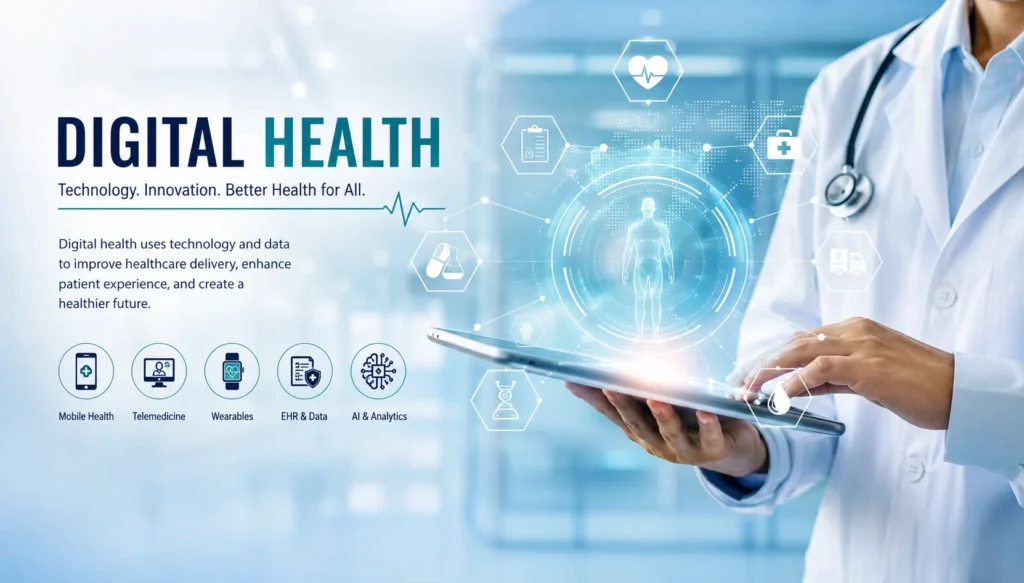
Healthcare is undergoing one of the biggest transformations in history. Advances in technology have changed how patients access healthcare, how physicians diagnose diseases, and how healthcare organizations deliver services. At the center of this transformation is Digital Health—an ecosystem of technologies, data, and digital solutions designed to improve healthcare delivery, enhance patient experiences, and achieve better health outcomes.
The COVID-19 pandemic further accelerated the adoption of digital health and health technology by demonstrating the importance of remote consultations, digital monitoring, and data-driven healthcare systems. Today, health technology is no longer an emerging trend but a strategic necessity for healthcare providers, governments, insurers, pharmaceutical companies, and technology organizations worldwide.
This article explores digital health and health technology, its components, benefits, challenges, emerging technologies, and future opportunities.
What is Digital Health?
Digital health and health technology refers to the use of digital technologies to improve the prevention, diagnosis, treatment, management, and delivery of healthcare services. It combines healthcare, information technology, artificial intelligence, big data analytics, wearable devices, mobile applications, cloud computing, and telecommunication to create a connected healthcare ecosystem.
According to the World Health Organization (WHO), digital health and health technology encompasses eHealth, mobile health (mHealth), telemedicine, health information systems, wearable technologies, artificial intelligence, and other digital innovations that support healthcare services.
Unlike traditional healthcare systems that rely heavily on face-to-face interactions and paper-based records, health technology enables continuous, personalized, and data-driven care regardless of geographical boundaries.
Quick Summary
Digital Health is transforming healthcare by combining technologies such as artificial intelligence (AI), telemedicine, electronic health records (EHRs), wearable devices, mobile health (mHealth), and data analytics to deliver more accessible, efficient, and patient-centered care. This comprehensive guide explains what Digital Health is, explores the core technologies driving healthcare innovation, highlights its benefits and challenges, and examines future trends shaping the evolution of modern healthcare. Whether you are a healthcare professional, technology leader, researcher, or simply interested in the future of medicine, this article provides a practical overview of how Digital Health is improving patient outcomes and healthcare delivery worldwide.
Transformation Of Digital Health
How Digital Health is Transforming Healthcare and Healthcare Technologies?
Healthcare systems across the globe face numerous challenges, including rising healthcare costs, aging populations, shortages of healthcare professionals, and increasing prevalence of chronic diseases. Digital health or health technology offers innovative solutions to address these issues.
Some of the key reasons digital health is becoming essential include:
- Improving accessibility to healthcare services
- Reducing healthcare costs
- Enhancing patient engagement
- Supporting preventive healthcare
- Enabling remote monitoring
- Improving clinical decision-making
- Increasing operational efficiency
- Expanding healthcare services to rural and underserved communities
Digital health and health technology technologies empower both patients and healthcare providers to make faster, more informed decisions based on real-time health data.
Important Digital Health Technologies
Core Technologies Driving Digital Health and Health Technology?
- Telemedicine and Telehealth
Telemedicine allows healthcare professionals to consult, diagnose, and treat patients remotely using video conferencing, telephone calls, and online platforms.
Telehealth is broader and includes patient education, remote consultations, health coaching, and virtual rehabilitation.
Benefits include:
- Reduced travel time
- Faster specialist access
- Improved convenience
- Better continuity of care
- Lower healthcare costs
Telemedicine has become particularly valuable for follow-up consultations, mental health services, and chronic disease management.
- Electronic Health Records (EHRs)
Electronic Health Records replace traditional paper-based medical records with secure digital records containing patient demographics, medical history, medications, laboratory results, imaging reports, allergies, and treatment plans.
Advantages include:
- Improved data accessibility
- Reduced medical errors
- Better care coordination
- Faster clinical decisions
- Enhanced patient safety
Integrated EHR systems also facilitate information sharing across hospitals, clinics, laboratories, and pharmacies.
- Mobile Health (mHealth)
Mobile health refers to healthcare services delivered through smartphones and tablets.
Popular mHealth applications include:
- Medication reminders
- Appointment scheduling
- Fitness tracking
- Diet management
- Mental health support
- Diabetes monitoring
- Pregnancy tracking
- Sleep monitoring
These applications encourage individuals to actively participate in managing their own health.
- Wearable Health Devices
Wearable technologies continuously monitor physiological parameters using sensors embedded in smart devices.
Examples include:
- Smartwatches
- Fitness bands
- ECG monitors
- Blood pressure monitors
- Continuous glucose monitors
- Smart rings
Wearables can measure:
- Heart rate
- Blood oxygen levels
- Physical activity
- Sleep quality
- Stress levels
- Calories burned
The collected data helps healthcare providers identify early warning signs and personalize treatment plans.
- Artificial Intelligence in Healthcare and Healthcare Technologies
Artificial Intelligence (AI) is transforming healthcare by analyzing vast amounts of medical data faster and more accurately than traditional methods.
Applications include:
- Medical image analysis
- Disease prediction
- Drug discovery
- Clinical decision support
- Personalized treatment recommendations
- Virtual health assistants
- Predictive analytics
AI helps clinicians improve diagnostic accuracy while reducing workload and operational costs.
- Internet of Medical Things (IoMT)
The Internet of Medical Things connects medical devices through the internet, enabling continuous monitoring and data exchange.
Examples include:
- Connected insulin pumps
- Smart inhalers
- Remote cardiac monitors
- Hospital asset tracking systems
- Connected ventilators
IoMT enables healthcare providers to monitor patients remotely while improving response times during emergencies.
Benefits of Digital Healthcare and Health Technology for Patients and Providers
Improved Patient Experience
Patients can access healthcare services anytime through mobile applications and teleconsultations. Digital platforms reduce waiting times and make healthcare more convenient.
Better Clinical Outcomes
Continuous monitoring enables early disease detection, timely interventions, and personalized treatment plans, leading to improved health outcomes.
Cost Reduction
Digital health and health technology minimizes unnecessary hospital visits, reduces administrative costs, and optimizes healthcare resources through automation and remote care.
Data-Driven Decision Making
Healthcare providers can leverage analytics and AI to identify disease patterns, monitor population health, and support evidence-based clinical decisions.
Enhanced Preventive Care
Digital health emphasizes prevention rather than treatment by encouraging healthy lifestyles, regular monitoring, and early risk identification.
Challenges of Health Technology
Despite its advantages, health technology faces several challenges.
Data Privacy and Security
Healthcare data is highly sensitive. Protecting patient information from cyberattacks, unauthorized access, and data breaches remains a major concern.
Digital Divide
Many rural communities and low-income populations have limited internet connectivity, digital literacy, or access to smart devices, restricting the adoption of digital health.
Interoperability Issues
Healthcare organizations often use different software systems that cannot communicate effectively, making seamless data sharing difficult.
Regulatory Compliance
Digital health solutions must comply with healthcare regulations related to patient privacy, data protection, medical device approval, and clinical safety.
User Adoption
Successful implementation requires healthcare professionals and patients to adapt to new technologies. Resistance to change and inadequate training can slow adoption.
Challenges Facing Digital Health and Health Technology Adoption
Digital health and health technology continues to evolve rapidly. Some emerging trends include:
Generative AI
Large Language Models are assisting clinicians by summarizing patient records, generating clinical documentation, supporting research, and enhancing patient communication.
Personalized Medicine
Genomics, AI, and predictive analytics enable treatments tailored to an individual’s genetic profile, lifestyle, and medical history.
Digital Therapeutics
Software-based therapeutic interventions are increasingly used to treat chronic diseases, mental health conditions, insomnia, and substance abuse alongside traditional medical care.
Remote Patient Monitoring
Healthcare providers continuously monitor patients with chronic conditions such as diabetes, hypertension, and heart disease using connected devices that transmit real-time health data.
Blockchain in Healthcare
Blockchain technology enhances the security, transparency, and integrity of medical records while improving data sharing among authorized healthcare providers.
Real-World Applications of Digital Healthcare and Health technology
Digital health and health technology supports numerous medical specialties and healthcare services.
Examples include:
- Remote cardiology consultations
- AI-assisted radiology diagnostics
- Virtual mental health counseling
- Diabetes management platforms
- Oncology treatment monitoring
- Maternal and child healthcare
- Elderly care monitoring
- Emergency response systems
- Home healthcare services
- Population health management
Healthcare organizations increasingly integrate these technologies into routine clinical workflows.
Future Trends in Digital Health and Health Technology
The future of healthcare will be increasingly digital, connected, and patient-centered. Technologies such as artificial intelligence, digital twins, robotics, augmented reality, and predictive analytics are expected to transform diagnosis, treatment, and disease prevention.
Hospitals will evolve into intelligent healthcare ecosystems where medical devices, electronic health records, wearable technologies, and AI platforms work together to deliver personalized and proactive care.
Rather than replacing healthcare professionals, health technology will augment their capabilities by reducing administrative burdens, improving diagnostic accuracy, and enabling more informed clinical decisions.
Conclusion
Digital health and health technology represents a paradigm shift in healthcare delivery. By integrating technology with clinical expertise, it enables more accessible, efficient, and personalized care for patients while improving operational performance for healthcare organizations. From telemedicine and electronic health records to artificial intelligence, wearable devices, and remote monitoring, health technology is reshaping every aspect of the healthcare ecosystem.
Although challenges such as data privacy, interoperability, regulatory compliance, and digital inclusion remain, continued investment in technology, infrastructure, and workforce development will accelerate adoption. As innovation continues, digital health and health technology will play a pivotal role in creating resilient, patient-centric, and data-driven healthcare systems capable of meeting the evolving needs of populations around the world.